
Arding & Hobbs represents a mixed-use restoration of a disused Grade-II listed 19th-centurt landmark department store in Clapham Junction, revitalising a historic streetscape and activating the street level with brand-new amenities for the public.
Arding & Hobbs started life in 1876 as the Falcon Road Drapery Store, named after the Falcon Brook, one of London’s ‘lost rivers’ which flows beneath the street on which the building is located. The original store was destroyed by fire in 1909, which saw 30 people hospitalised and killed eight. Such was the devastation the fire was reported as far afield as the Sydney Herald. The repercussions of the conflagration were significant as they lead to a new regime of fire safety regulations that sought to control fire spread in large buildings.
Arding & Hobbs was rebuilt and reopened for business in 1910, designed by Gibson, Skipwith and Gordon in the Edwardian Baroque style. It is a fine building. The prominent corner site is articulated with an elaborate cupola that makes a sophisticated formal gesture to its pivotal corner site on one of South London’s main junctions. The lower two floors are characterised by elaborate dark steel windows with an arch motif, above which are a further two floors of red brick with stone aperture detailing, pilasters and cornicing, culminating in the corner stone and glass cupola.
The iconic Grade II listed department store, had served as a focal point for the neighbourhood until falling into disrepair with the liquidation of Debenhams in 2020. Recognising the historic building’s value to the community, developer W.RE has restored and expanded it, introducing a high-quality, inspirational workspace for around 1000 people, and breathing new life into this cherished landmark.
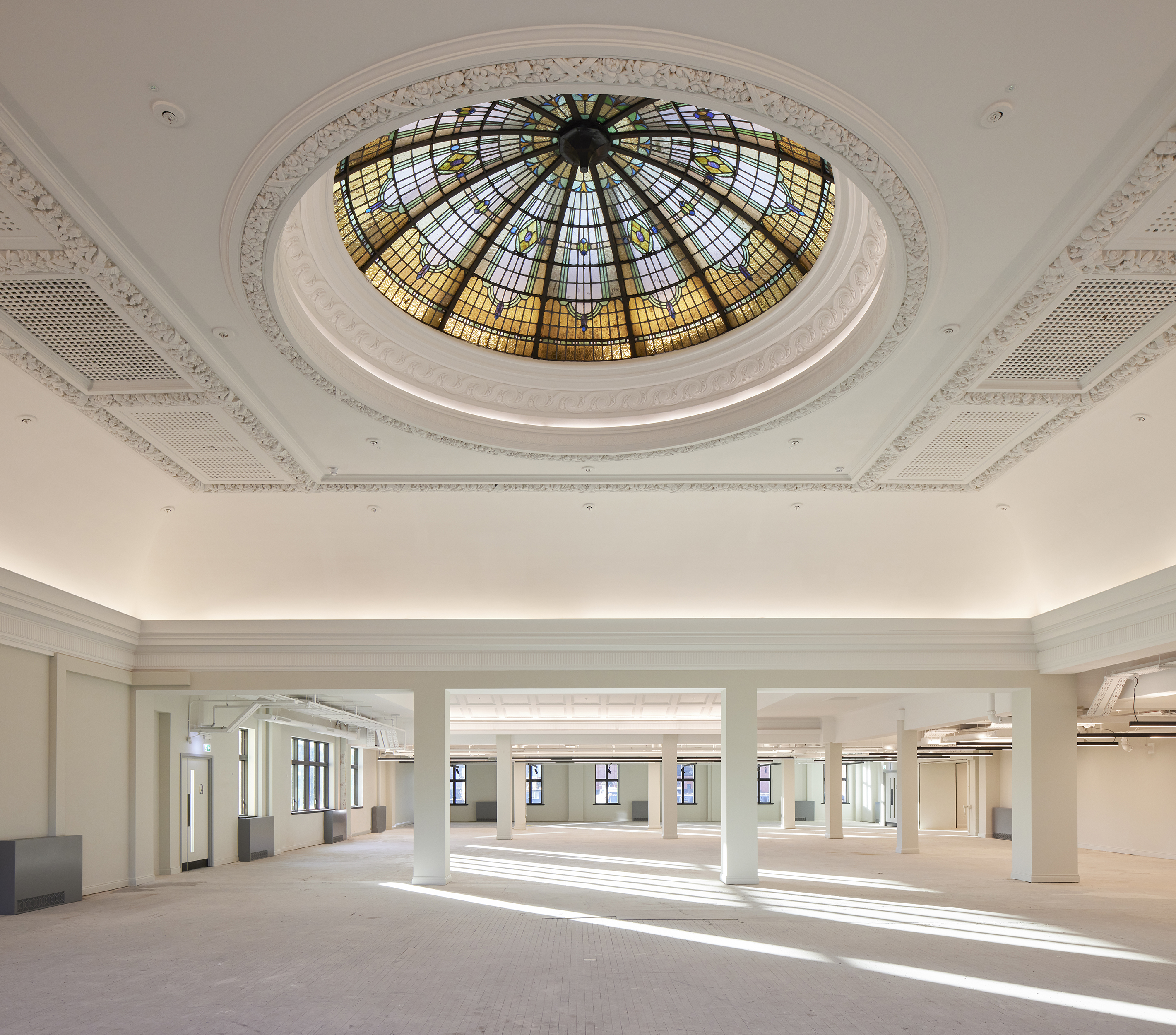
Working with architects Stiff+Trevillion, W.RE peeled away decades of retail fixtures and fittings to expose original features such as brick and stone walls, a spectacular stained-glass dome and a large barrel-vaulted stained-glass roof, which had been concealed by many layers of paint. The glass roof alone took three weeks for conservationists to restore by hand using toothbrushes and vinegar.
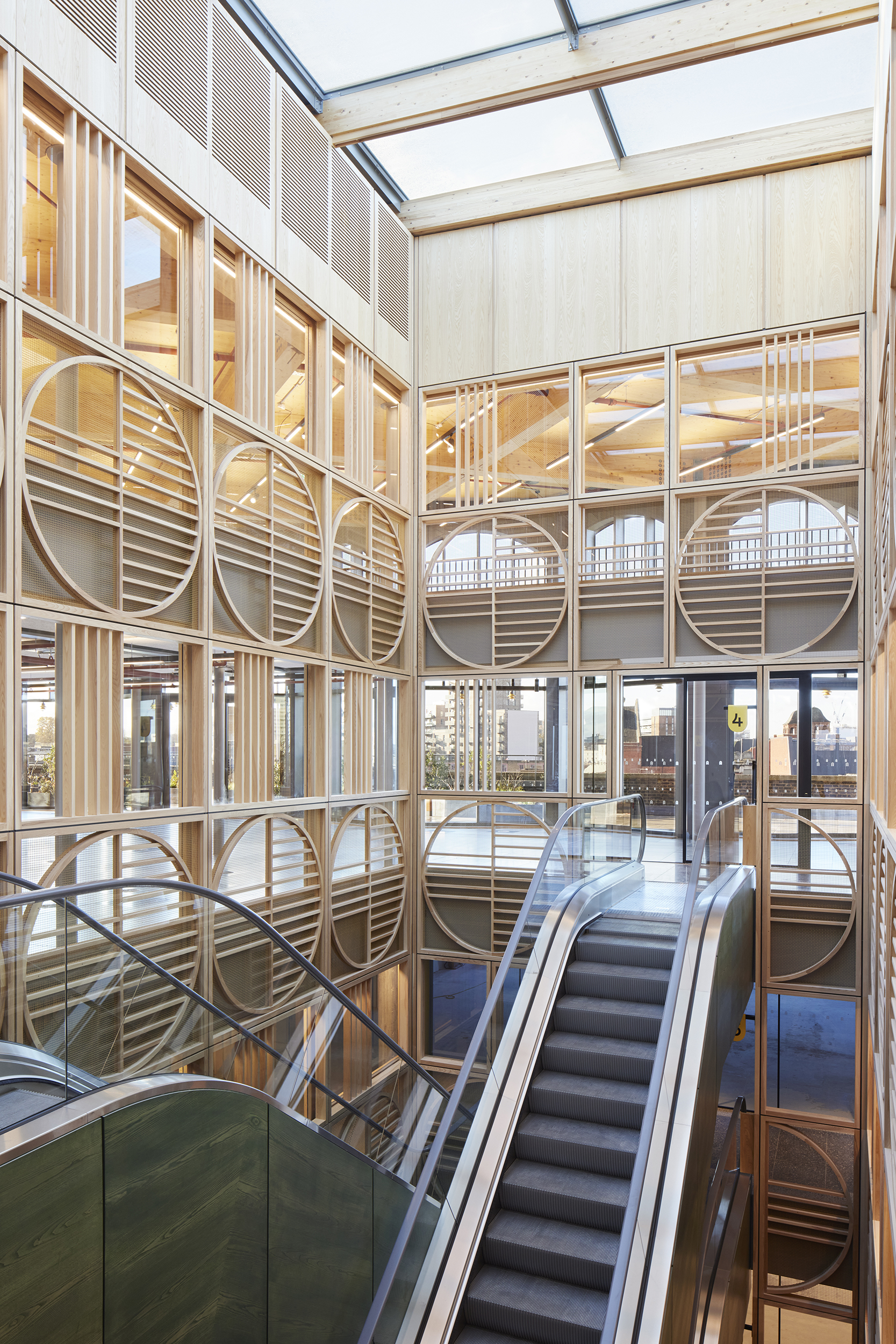
Making the transition from dilapidated department store to Grade A office space required complex intervention work. Opening up the department store’s constricted upper floors allowed for multiple configurations of the floorplates and for additional uses to be introduced in the future. To improve daylight penetration, windows on the building’s internal walls were created, served by a dramatic central lightwell.
The design picks up on the principal architectural motifs of the existing building and cleverly combines them with ideas of pleating and stitching from the building’s former life as a drapery. The arch motif from the metal windows is reworked as a filigree timber frame that lines the central atrium which connects all floors of the building with a grand escalator, itself reminiscent of the departments stores of yesteryear. The finely detailed glass and ask screen is used as a counterpoint to the ‘as-found’ roughness and the historic fragments of the existing building. The atrium is rooflit and drops light into the heart of the new building and structures the new entrance sequence.
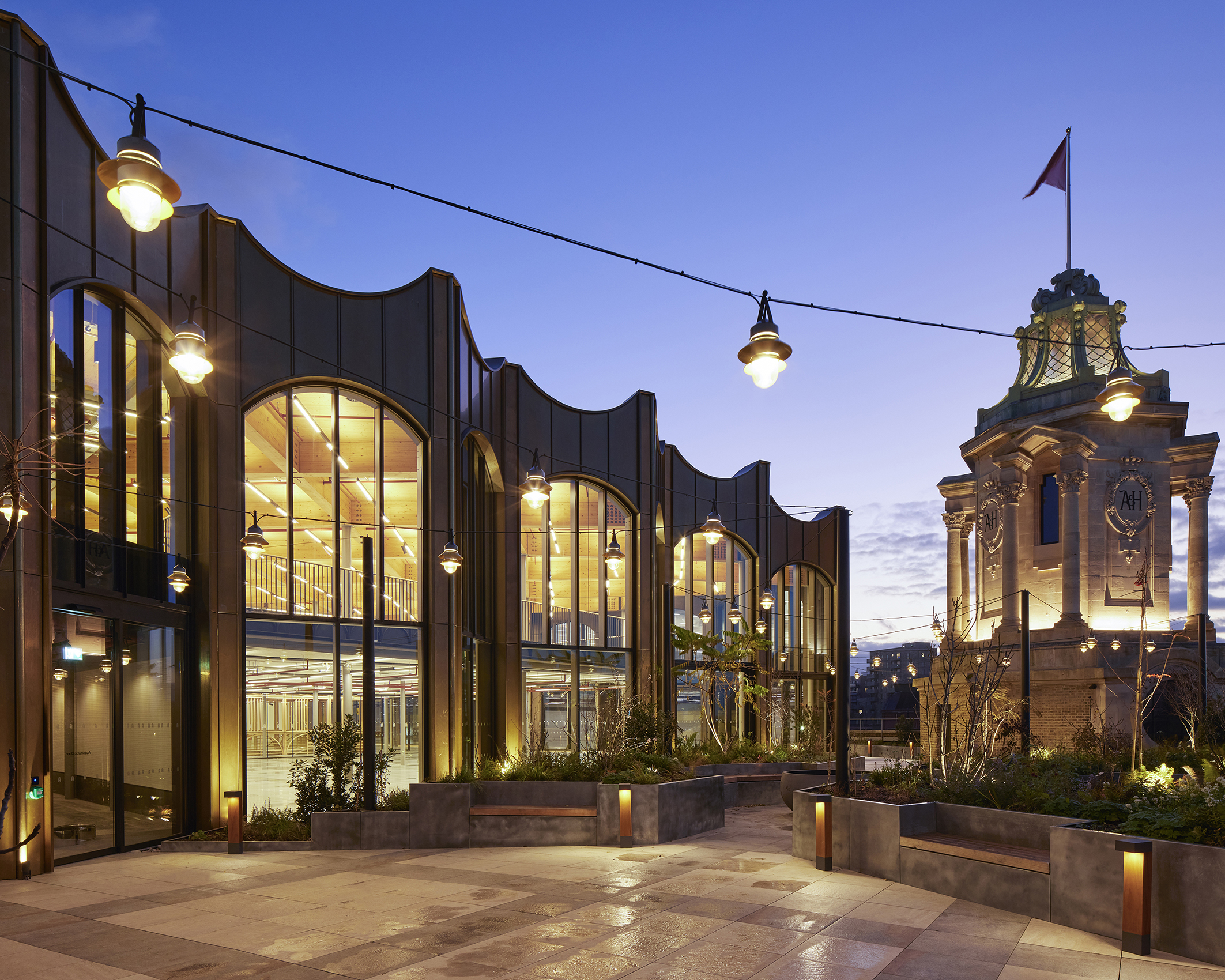
The project also added a new, innovative 8-meter ‘crown’ at the top, enhancing workspace and providing access to a rooftop terrace with panoramic views of London.
Recognising the need for an inclusive and reflective space, extensive public consultations ensured the community’s voice shaped the building’s future. With over 1,000 responses-surpassing even Battersea Power Station’s consultation - Arding & Hobbs has been revitalised into a community asset, transforming the area into a 24/7 destination.
A range of exciting retail and leisure uses accounting for around 30% of the total floorspace now occupy the ground, and first floors, including a gym, Italian delicatessen, and a large corner café/restaurant, alongside a pre-existing clothing retailer which continued trading throughout the entire refurbishment.
The vast majority of the existing building was retained, minimising the carbon impact through reduced embodied energy. New elements were constructed primarily from timber, aiming for carbon neutrality.
Non-original existing glazing was replaced to reduce energy consumption for heating and cooling, following an energy reduction hierarchy: lean, clean and green. High-efficiency mixed-mode ventilation with heat recovery and LED lighting cut energy use. Office heating is provided by a VRF system, eliminating gas usage. An onsite photovoltaic array supplies some of the building’s electricity, while green and brown roofs, along with roof terrace plantings, enhance local ecology.
The building provides the borough of Wandsworth, which has risen up the office desirability rankings in recent years, with the exceptional quality workspace surrounded by a strong mix of uses. The project has been revitalised into a community asset, transforming the area into a 24/7 destination.
Project Data
Client: W.RE
Main Contractor: Knight Harwood
Chartered Building Company: Restore London
Project Manager: Blackburn & Co
Quantity Surveyor: Exigere
Services Engineer: Norman Disney Young
Structural Engineer: AKT-II Structures
Historic Buildings Consultant: KM Heritage
Planning Consultant: DP9
Architect: Stiff+Trevillion
IMAGE CREDITS
Image 1: Rooftop view from Arding & Hobbs at night
Image 2 & 3 : Interior in Arding & Hobbs building
Photography by Richard Chivers